

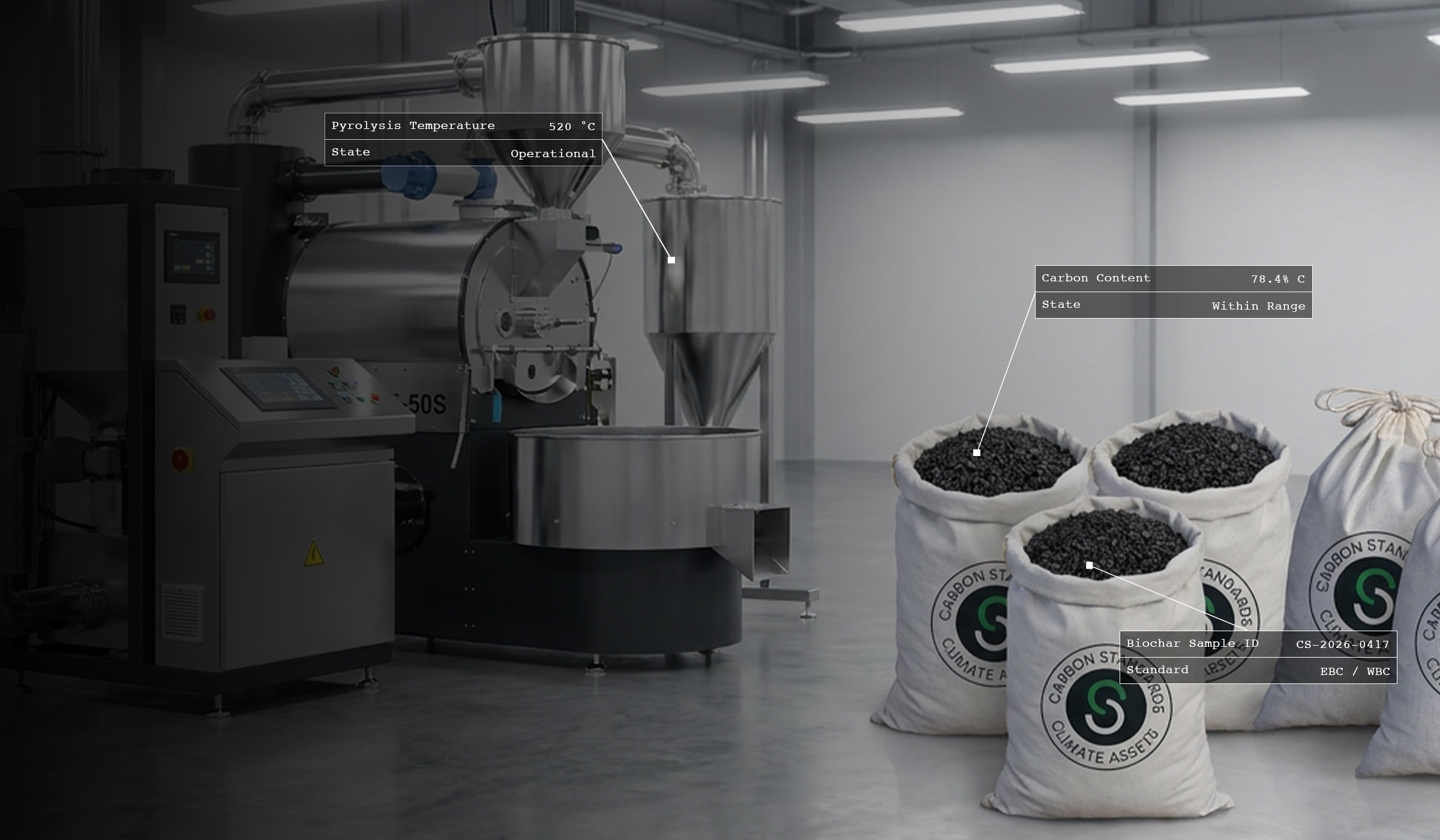
The Evidence Behind Trusted Climate Assets
Find the requirements, processes and resources for dMRV providers, laboratories and Validation and Verification Bodies.
dMRV · General requirements
These requirements apply across the Global C-Sink standards and are assessed alongside the specifications of the selected standard.
-
01
Quality management documentation
English user manual, system flowchart, technical description, data-quality process, system access and data-security strategy.
-
02
Data collection
All data and information required by the applicable standard must be tracked.
-
03
Aggregation and consolidation
Standard calculations and aggregation must be visible and traceable through internal identification numbers.
-
04
Accuracy and reliability
Built-in plausibility checks and data-quality controls must protect submitted information.
-
05
Emission factors and defaults
Show equations, CSI-approved emission factors, sources and the applicable margin of security.
-
06
Security and privacy
Documented data security, privacy and backup procedures, such as ISO 27001 or equivalent practices.
-
07
Operational use
The system must contain data from actual production, for example through a pilot phase.
-
08
English-language access
All relevant web interfaces and smartphone applications must be available in English.
-
09
Clear responsibility
Distinguish data entered by users from data entered or defined by the dMRV provider.
-
10
Archive and transfer
Archive tracked data for ten years and submit C-Sink Units through the Global C-Sink Tool.
dMRV · Standard-specific requirements
Preview the relevant section online or download the full official endorsement documentation.
-
Document 01
Global Artisan C-Sink
Specific dMRV requirements for distributed biochar projects.
-
Document 02
Global Biochar C-Sink
Specific dMRV requirements for tracking certified biochar from production through application.
If the preview does not load, use “Open” to view the document in a new tab or “Download” to save it.
How to become an endorsed laboratory
Reliable analysis for credible certification.
Endorsed laboratories determine biochar quality and support carbon-sink calculations through consistent analytical methods and quality controls.
View full guidance for laboratoriesHow to become an endorsed laboratory
-
01 Review
Endorsement scope
Review the relevant process and confirm the analyses and standards your laboratory supports.
-
02 Register
Submit documentation
Provide evidence of methods, competence and quality management.
-
03 Demonstrate
Analytical quality
Show that sampling, methods, controls and reporting meet requirements.
-
04 Maintain
Ring trials
Endorsed laboratories and subcontractors participate annually in an independent biochar ring trial.
How to become a validation and verification body
Independent assurance at project level.
Approved, qualified and independent VVBs assess whether projects meet the applicable standard and whether reported outcomes have been achieved and correctly quantified.
Register your interest as a VVBHow to become a validation and verification body
-
Validation
Review project design
Assess the PDD, eligibility, methodology and project systems before issuance.
-
Verification
Confirm outcomes
Verify monitored results, including on-site inspection where required.
-
Evidence
Access records
Review reports, annexes, certificates, GPS data, transactions and protected dMRV records.
-
Workflow
Global C-Sink Tool
Submissions create the verification task and deeplinks connect reviewers to detailed evidence.
Become a Carbon Standards verification partner.
Tell us whether you are a dMRV provider, laboratory or Validation and Verification Body. Our team will direct you to the relevant requirements and process.