You can’t simply make biochar, bury it in the soil, and start issuing carbon credits.
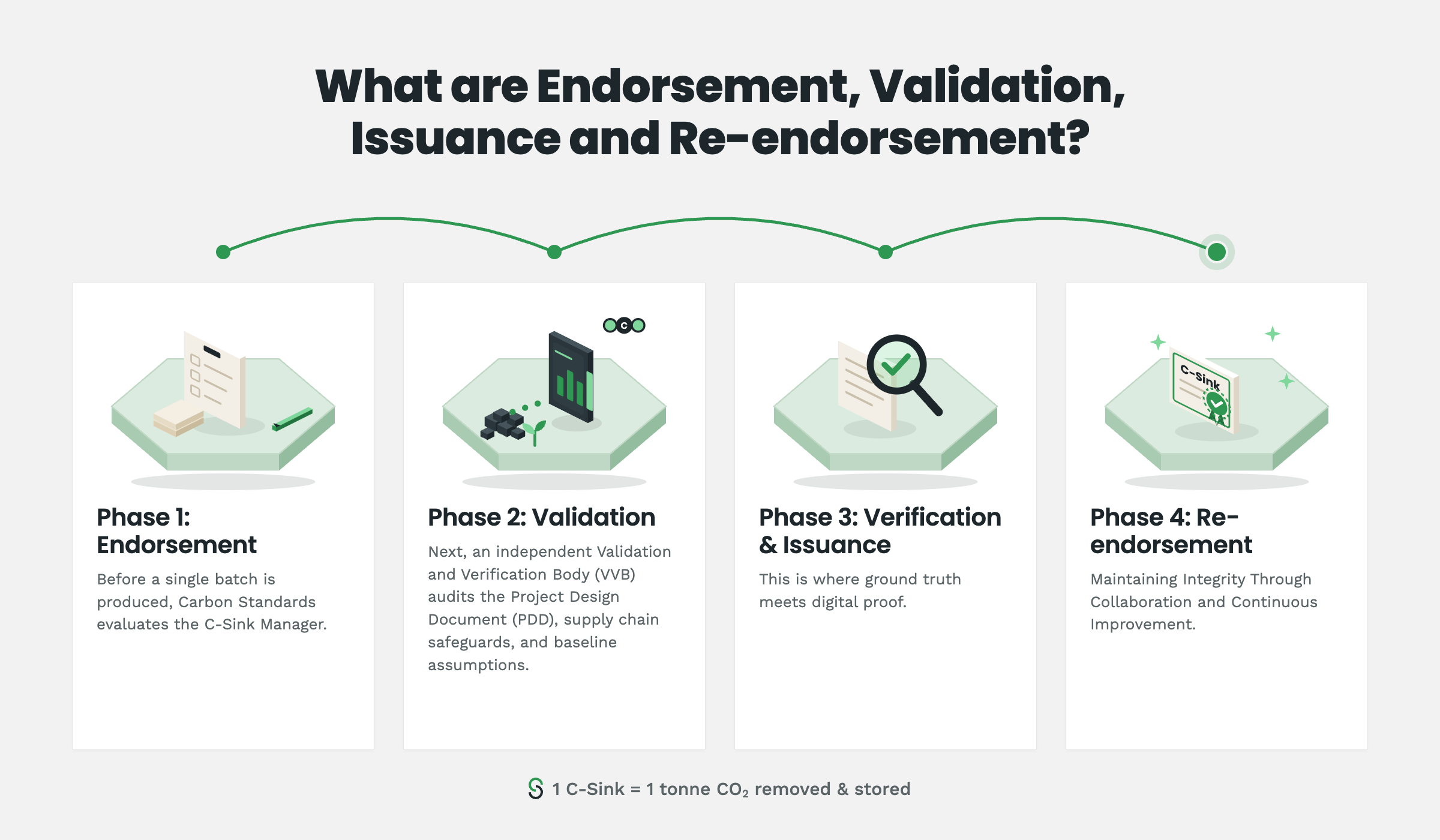
In high-integrity carbon markets, trust is not a marketing claim. It's built on a rigorous three-phase standard. Endorsement -> Validation -> Issuance
If you’ve ever wondered how an artisanal biochar project turns from a simple concept into a verified carbon asset, here is what the journey looks like behind the scenes.
Phase 1: Endorsement
Before a single batch is produced, Carbon Standards evaluates the C-Sink Manager. We look at the full picture: project type, feedstock, dMRV software, pyrolysis technology, methane avoidance strategies, and mandatory team training. The result? An official designation as an Endorsed Artisan C-Sink Manager.
Phase 2: Validation
Next, an independent Validation and Verification Body (VVB) audits the Project Design Document (PDD), supply chain safeguards, and baseline assumptions. The project then goes public for a 30-day consultation on the Global C-Sink Registry. The result? Once all checks pass, the project is officially registered as "Validated."
Phase 3: Verification & Issuance
This is where ground truth meets digital proof. Auditors visit the site to inspect biomass storage, bulk density, and on-farm application. Meanwhile, the endorsed dMRV app uploads geotagged, time-stamped batch data every time biochar is applied to the soil. The result? Carbon Standards issues fully traceable C-Sinks.
Phase 4: Re-endorsement
Maintaining Integrity Through Collaboration and Continuous Improvement
Each year we meet with our C-Sink Managers to review ongoing compliance, discuss operational challenges, and identify opportunities for improvement.
Re-endorsement is more than a compliance checkpoint. It is an opportunity to strengthen collaboration, accountability, and project performance on the ground.
High integrity is not a one-time achievement but rather an ongoing commitment built on trust, collaboration, and continuous improvement.