Certification does more than raise farm incomes. It builds economic momentum behind agricultural climate services - a practical way for rural communities to be rewarded for climate action already underway.
Global Artisan C-Sink Standard.
Biochar production in lower-income countries
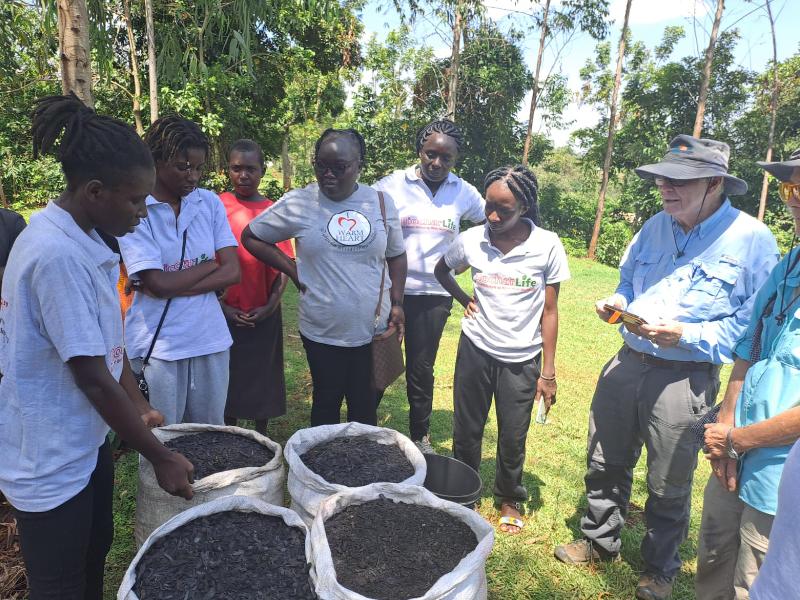
Biochar made by farmers.
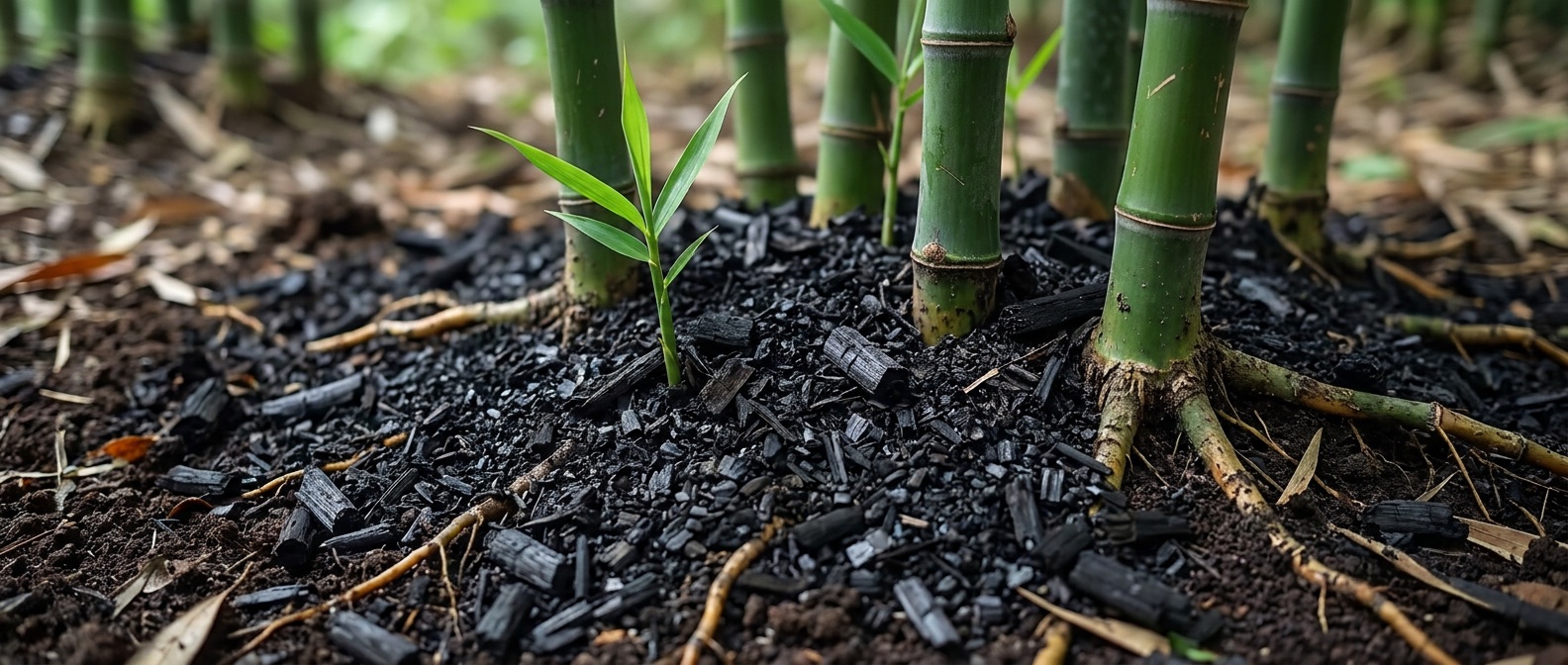
For over two thousand years, people have made charcoal and biochar to heat homes, cook food, and enrich the soil. The Global Artisan C-Sink Standard builds on that tradition - setting out how to produce, process, and apply biochar in agriculture and other industries across low-, lower-middle-, and upper-middle-income countries (see the World Bank's income classification).
Carbon Standards pioneered carbon certification for distributed biochar production. The Global Artisan C-Sink was the first standard of its kind, paving the way for many farmers and cooperatives to access carbon markets through the Global C-Sink Registry.
The Artisan Standard guarantees that feedstock is grown sustainably and that biochar is made the artisan way, using Kon-Tiki (flame-curtain) pyrolysis to keep production emissions low. Every aspect of quality is measured and documented.
Worked into agricultural soil, the biochar stores carbon and generates C-sink credits - sold as CO2 certificates on established trading platforms, and turning carbon removal into income for farmers.
For Suppliers
Suppliers may be farmer groups, NGOs, or organizations capable of producing biochar using best management practices and strict monitoring.
Participating in this program creates meaningful employment for local farmers and communities. Additionally, generating carbon credits unlocks an extra revenue stream for artisans and key stakeholders, driving local economic growth aside of the agricultural benefits.
For Buyers
Artisan Credits offer a unique opportunity to make a tangible, direct impact. By purchasing these credits, your business actively empowers farmers and drives decentralized climate action.
Every Artisan Credit carries its own story of local impact. It delivers a powerful message: carbon reduction isn't driven only by industrial giants, but by everyday farmers who are preserving nature while helping you meet your net-zero goals
Standard details

Here you will find the current version of our standard. Preview the document before opening or downloading it.
If the preview does not load, use “Open” to view the document in a new tab or “Download” to save it.

- Rule update: Dry Matter AssessmentPreview
- Rule update: Diffuse C-SinksPreview
- Rule update: Biochar in concrete construction materialsPreview
If the preview does not load, use “Open” to view the document in a new tab or “Download” to save it.
Additional clarification and guidance:
- Matrix positive list for Biochar C-SinkPreview
- Clarification: Bulk density analysis for biochar produced in a Kon-TikiPreview
- Clarification: Extension of projects or their hand-overPreview
- Clarification: Retrospective issuance of C-sinksPreview
- Clarification: Leakage EmissionsPreview
- Clarification: Methane emission compensationPreview
- Clarification: Implementation PartnerPreview
- Clarification: Increased production allowance for Artisan ProPreview
- Clarification: Dry Matter Assessment Calculator
- Clarification: Positive List of Permissible Biomass for ArtisanPreview
- Clarification: Dry Matter Assessment - Laboratory ProtocolPreview
If the preview does not load, use “Open” to view the document in a new tab or “Download” to save it.
The issuance process for carbon credit in the Global Artisan C-Sink standards revolves around empowering smallholder farmers.
The following points of the project eligibility must be fulfilled:
- Production of biochar according to Global Artisan C-Sink conditions.
- Farmers and Artisan Biochar Producer are not certified under any other methodology for nature-based climate service (i.e. biomass production and soil organic carbon).
- Social Impact: Involved parties have to be compensated fairly and transparently.
- Project location: Project is located in low- or middle-income country according to the World Bank classification.
- Biochar production does not exceed 100m³/year for a single C-Sink Farmer or 1500m³/year for a single Artisan Pro and is done with a low-tech production unit.
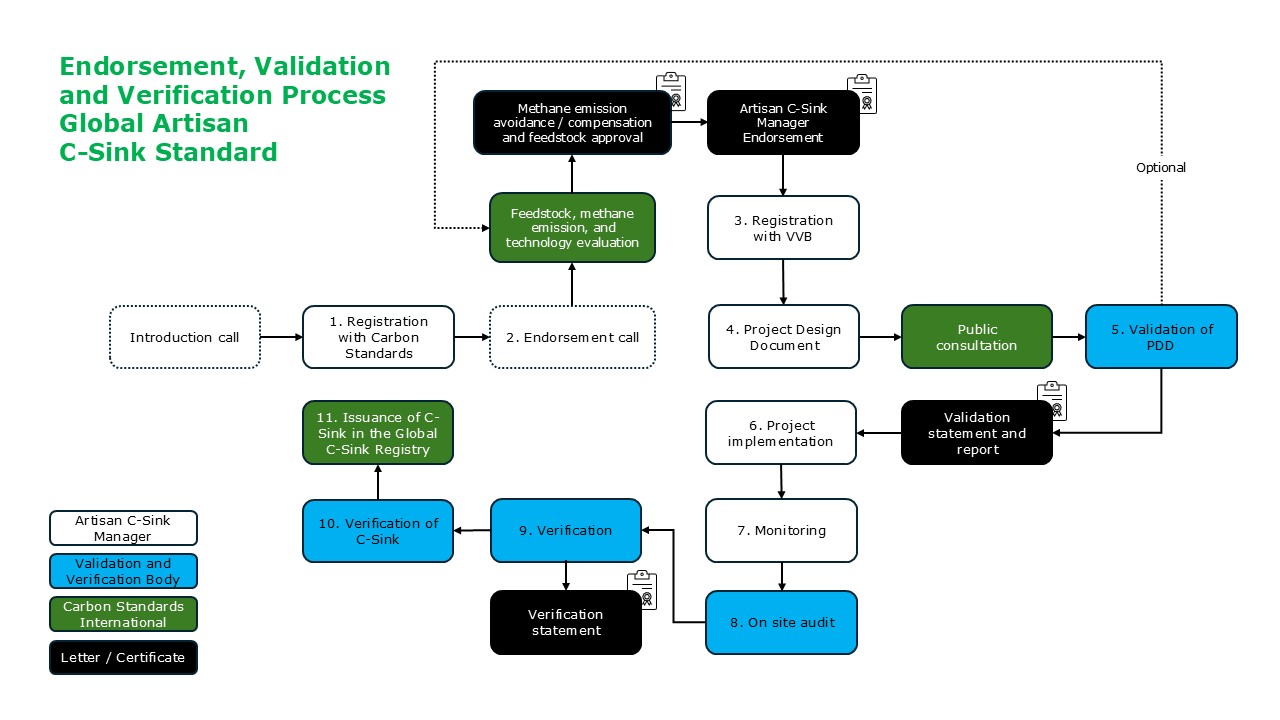
The endorsement and validation/verification process consists of three phases:
-
Endorsement
The endorsement phase by CSI to check if the Artisan C-Sink Manager fulfil basic requirements and the understanding of the process.
-
Validation
During the validation it will be checked whether a project meets all rules and requirements from the Global Artisan C-Sink standard and is conducted by approved, qualified and independent Validation and Verification Bodies (VVB).
-
Verification
The verification by a VVB confirms that the outcome set out in the project document description (PDD) has been achieved and quantified according to the requirements of the Global Artisan C-Sink Standard and includes an on-site inspection by the VVB.
If the preview does not load, use “Open” to view the document in a new tab or “Download” to save it.
Process flowchart · click to enlarge
Registration Process
After an initial contact via the email address [email protected], the next step is to register to start the endorsement process.
Endorsement Process
In the endorsement process, the aim is to clarify the basic requirements and to make certain technical clarifications. This includes, among other things, dMRV, pyrolysis technologies, and possible methane compensations. Additionally, the Project Design Document (PDD) and the process will be explained in detail.
Project Design Document
The Project Design Document (PDD) describes your project activity, from biomass sourcing to the methane compensation plan. The calculation formulas in the PDD enable external parties to understand the activities and the calculation of the C sinks. Below are the documents you need for the process.
Watch our webinar about PDD.
Project Design Document: This document can be used in parallel with other versions published after February 19, 2026. The date can be found in the footer.
- Project Design Document template (PDD) for Global Artisan Standard
- Validation and re-validation of PDDPreview
- Monitoring report template
- Annex monitoring report template
- Farmer’s Declaration of honour, examplePreview
- Calculation Ex-Ante Estimation
- Labor rights and working conditions
If the preview does not load, use “Open” to view the document in a new tab or “Download” to save it.
Endorsement of a new dMRV provider:
There is an increasing demand for digital Monitoring, Reporting, and Verification (dMRV) provider in the biochar production sector, particularly focusing on smallholder farmers. Please find the requirement to become a dMRV provider in this document below:
If the preview does not load, use “Open” to view the document in a new tab or “Download” to save it.
Find here a list of endorsed dMRV providers for Global Artisan C-Sink:
Endorsement of new system provider:
Carbon Standards welcomes an Artisan C-Sink Manager who wants to develop their own low-tech pyrolysis technology, which will require a separate endorsement for the project. Please find the required document below:
If the preview does not load, use “Open” to view the document in a new tab or “Download” to save it.
Find here a list of endorsed system providers for Global Artisan C-Sink:
Endorsement of a new C-Sink Trader:
This role is crucial in creating a transparent and efficient marketplace, where carbon sinks are accurately quantified, verified, and traded, ensuring that efforts to offset emissions are both credible and impactful.
If the preview does not load, use “Open” to view the document in a new tab or “Download” to save it.
C-Sink Traders are authorized to conduct both transfers and retirements in the Global C-Sink Registry.
Find here a list of endorsed C-Sink Traders:
Find a list of IT Tools applicable to the Global Artisan C-Sink Standard here:

Find a list of all endorsed equipment here.
Endorsement of a new laboratory:
Biochar laboratories play a crucial role in verifying carbon sequestration calculations and determining the quality of the biochar produced. Here you will find the document to recognise your laboratory:

Laboratory endorsement process
If the preview does not load, use “Open” to view the document in a new tab or “Download” to save it.
-
ENVIRO ANALYSTS AND ENGINEERS PRIVATE LIMITEDRow House No.2, Shalom Garden, Opp. Kanakia College,
Website
100ft, Kanakia Road, Miraroad (East),
Thane -401107
India
Tel.: +91 9321619726/ 7208284644/ 9967721437
E-Mail: [email protected] -
Eurofins Umwelt Ost GmbHFreiberg Branch
Website
Freiberg East industrial estate
Lindenstraße 11
D-09627 Bobritzsch-Hilbersdorf
Germany
Phone: +49 3731 2076 - 500
E-mail: [email protected] -
Ohm Laboratory Private LimitedPlot No-281, Udhyog Kendra II, Ecotech III,
Website
Greater Noida, Uttar Pradesh,
India - 201306 -
QSS Inspection and Testing Private LimitedPlot No. 70 & 71, 1st & 2nd Floor, Sector 19A, Vashi,
Website
Navi Mumbai 400705, Maharashtra, India
E-mail: [email protected] -
Ruhr Lab GmbHLaboratory at KW Scholven
Website
Glückaufstrasse 56
D-45896 Gelsenkirchen
Germany
E-mail: service(at)ruhr-lab.de
-
CERES-CERT AGCERES-CERT AG is the third-party auditing body for the standards owned by Carbon Standards International.
Website
With the experience in the certification of biochar, CERES-CERT AG has the necessary expertise to certify biochar production and processing companies and to validate and verify your climate projects.
You can find more information and necessary documents in this section:
Bulk upload and Monitoring Report
These templates are used to submit project monitoring data to the C-Sink Tool, where the data is processed for transfer to the Global C-Sink Registry. The template has now been updated to also include the Dry Matter Assessment results, ensuring that the relevant dry matter data is submitted together with the monitoring information.
If the preview does not load, use “Open” to view the document in a new tab or “Download” to save it.
Principles and Requirements
- Principles of Global C-Sink StandardsPreview
- Flowchart and documentation of C-sink creationPreview
- Calibration of Measurement EquipmentsPreview
If the preview does not load, use “Open” to view the document in a new tab or “Download” to save it.
Find current certification and service fees on our Prices page.
Ongoing public consultation
As part of validation, projects go through public consultation where third parties can provide feedback. Find projects under consultation in the Global C-Sink Registry, marked “Ongoing Validation”.
If you would like to have Carbon Standards review potential modifications or amendments to the standard, please review the following:
- Pending requests - Standard amendments Global Artisan C-SinkPreview
- Flowchart request for amendment of standards and methodologiesPreview
- Development of standards and methodologies and their updatesPreview
If the preview does not load, use “Open” to view the document in a new tab or “Download” to save it.
Input from Public Consultation of Dry Matter Assessment (01/06/2026)
If the preview does not load, use “Open” to view the document in a new tab or “Download” to save it.
If you have any comments, please feel free to submit them using the form.
Standard updates
Here you find the old version of the standards including a marked version with the changes to the current version of the Global Artisan C-Sink.
- Global Artisan C-Sink 2.1Preview
- Global Artisan C-Sink 2.1A Track changesPreview
- Global Artisan C-Sink 2.0Preview
- Global Artisan C-Sink 1.0Preview
- Clarification on calculating the C-sink in Global Artisan C-Sink v1Preview
If the preview does not load, use “Open” to view the document in a new tab or “Download” to save it.
Interested in Global Artisan C-Sink certification?
Register your interest
Contact person
Luki Fathia
PM Global Artisan C-Sink
+41 (0) 62 552 10 93 luki.fathia@carbon-standards.comContact
Register your interest
To register for a certification service, please use the registration form.